It says what it is doing, even off.
What the device says before it has a position, when it is off, and when its cell runs out.
On the apron, and in the bag
It says what it is waiting for.
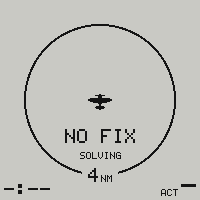
One press and it is on, straight to the traffic picture. Until it has a position the ring tells you so, and the word under it gives you how far the receiver has got: gone quiet, solutions arriving with no date on them yet, or a date read off a satellite.
That is the difference between a device to wait for and a device to carry into the open. The first fix announces itself, and the picture becomes a picture of the sky.
The wordmark on the glass means off.
A hold of two seconds switches it off: the radio is parked, the panel gets three seconds to draw the wordmark, and the rails drop when you let go. E-paper keeps its image with no power at all, so that is what an off device wears.
The same hold, a finger resting on the pad, leaves the glass blank instead. An image left on e-paper for a winter leaves a shadow the panel never loses again, and a device going into a cupboard should carry nothing.

A cell that runs out says so as it goes.
At 3.2 V the device switches itself off, and the last thing it writes is why. You pressed nothing, so the glass is the only thing that can tell you: without it, a device that stopped on its own is a device that crashed or died. The button stops working at the same moment, because a press could only reach the same cutoff again.
The cable is the way out, and it is one act. Plugging it in wakes the electronics, which refuse to become a device and put the wordmark back: an ordinary switched-off unit again, charging, and the next press starts it. A cell that emptied itself on a shelf wrote nothing, so there the press is what gets answered, with the same line.
The boot that follows remembers it. Its self test reads WAS FLAT beside the voltage, and a phone that connects during that boot is told the same, so a unit that went dark does not come back as if nothing happened.

| From off | What happens |
|---|---|
| Press the button | boots, unless the cell is under 3.4 V with no charger, and then the glass says FLAT BATTERY |
| Press after a flat-battery shutdown | nothing, by design: the glass already says it, and the cable is the way back |
| Plug the charger in | charges, stays off: a cable in a flight bag is not a request to transmit |
| Plug the charger into a flat device | charges, stays off, and the wordmark replaces FLAT BATTERY |
| Hold the button, plug the charger in | boots and charges |
| Press RST | reboots, and twice inside half a second, the USB bootloader |
Technical notes
Why the cell lasts the day.
Switching off is a sequence, not a rail drop, and the order is the content of it. The external flash is told to sleep while it still has a supply to hear the command: after the rail that command does nothing, and the part draws its full standby current for the whole night the device spends in a bag looking switched off.
The rest is the radio and the sensors. Airborne the device speaks once a second, parked once every ten, and which of the ten seconds is its own comes from its address, so a field full of aircraft spreads itself out.
- Radio asleep before its reset line
- Flash, receiver, rails, pins, in that order
- 1 Hz in the air, 0.1 Hz on the ground
- The hub’s gyroscope is never read: it costs a milliamp
- Charging refused outside 5 to 60 °C
- The lamp winks, and is never held solid
What the gauge will not do.
It reads two curves, not one. On a charger the terminal sits above the cell’s own voltage, so the same reading means a far emptier cell, and the percentage says which curve it read.
It never walks backwards, and a 22 dBm burst sagging the rail does not move it. A gauge that jumps when the radio keys is a gauge a pilot stops believing.
| Threshold | What it does |
|---|---|
| 3.60 V | low, about 12%: the lamp winks red, the radar says BAT and the percentage, and a switch-off leaves CHARGE BATTERY on the glass |
| 3.50 V | critical, about 5%: the lamp blinks every 600 ms, and from here nothing durable is written except the flight record, which is the evidence of the flight that is ending |
| 3.40 V | a boot on a cell this flat is refused, and the button is left unarmed so a bag cannot keep asking |
| 3.20 V | flat, the cutoff: the device switches itself off and leaves FLAT BATTERY on the glass. Every step takes three consecutive samples to reach and three to leave, so a transmit sag cannot act and a cell resting on a line cannot flicker across it |
| 1.80 V | below this the reading is a floating divider, not a flat cell, and nothing acts on it |